
Bangkok PM2.5 season: a practical home-care plan for older adults and families
How families can use official air-quality information to organise a cleaner indoor space, essential outings and timely medical help without turning one reading into a diagnosis.
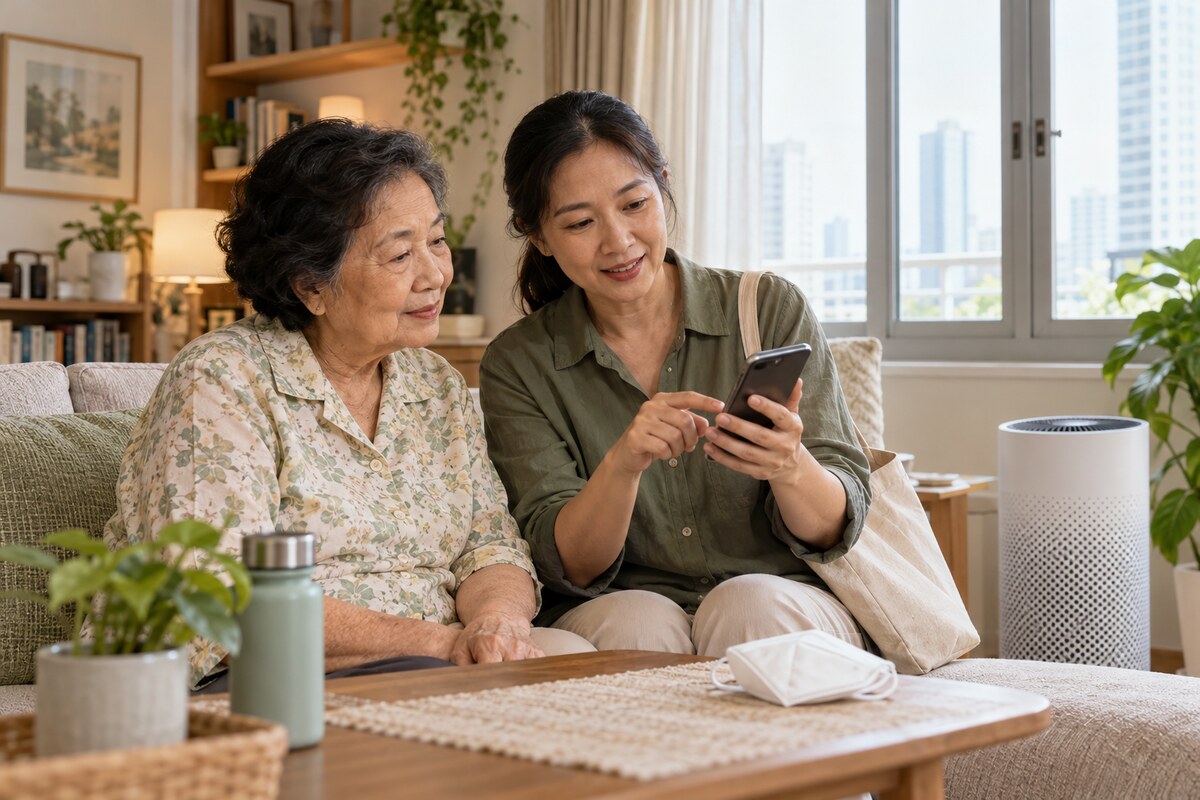
1. Why prepare now, even on a relatively clear day
Bangkok's Environment Department reported broadly good air quality on 28 October 2026, with district PM2.5 readings ranging from 13.1 to 24.9 micrograms per cubic metre, while noting an upward trend. This is exactly why a family plan should not begin only when the sky looks hazy. Fine-particle levels can vary by district, hour, weather and traffic, and a citywide summary may not describe the route to a hospital or the street outside a home. Thailand's high-PM2.5 period commonly extends from November to March, according to a Thai study published in 2026. The useful response is not alarm but readiness: decide which official source the family will check, who will help with necessary outings, and which room can become a cleaner-air space. This article provides general information, not individual medical advice. A single reading cannot diagnose illness, determine a person's private risk, or replace instructions from their clinician.
2. Read the number in context, not as a simple safe-danger switch
PM2.5 means airborne particles with an aerodynamic diameter of 2.5 micrometres or less. Because they are small, exposure is studied in relation to respiratory and cardiovascular outcomes, but a monitor reports outdoor concentration, not the dose received by one person. Thai health communication currently describes 15.1–25.0 micrograms per cubic metre as good, 25.1–37.5 as moderate, 37.6–75.0 as beginning to affect health and above 75 as affecting health, with more protective advice for people requiring special health care. The World Health Organization's 2021 guideline uses a more protective 24-hour reference level of 15 micrograms per cubic metre. These numbers serve different policy and communication purposes: the WHO level is a health-based guideline, not Thailand's legal alert threshold. Families should therefore follow local official advice while remembering that lower pollution is preferable and that risk changes with duration, activity, health conditions and ventilation.
3. Older age is a reason to personalise the plan, not to remove autonomy
Older adults are not one uniform risk group. A healthy 65-year-old who walks independently may need a different plan from an 82-year-old with chronic heart or lung disease, limited mobility or difficulty communicating symptoms. The practical question is not simply age; it is how exposure combines with health history, exertion, travel time, housing and the person's priorities. Families can ask the treating clinician in advance what symptoms should trigger a call, whether a mask is appropriate for that person, and whether any planned outdoor rehabilitation needs an indoor alternative on polluted days. The older person should remain part of these decisions whenever possible. Home assistance can support observation, transport and communication, but it should not silently restrict movement or change medicines. A good plan preserves choice: explain the reading, offer safer options and record the person's preference, while escalating only when symptoms or professional instructions justify it.
4. What the newest Thai study found—and what it did not prove
A 2026 time-series study followed respiratory health-care use among people aged 60 or older living within five kilometres of a newly industrialising area in central Thailand from November 2023 to March 2024. Researchers analysed 924 respiratory visits and used the nearest government monitoring station for exposure. Mean daily PM2.5 was 42.43 micrograms per cubic metre. A 10-microgram increase was associated with a 5.5% higher visit rate four days later, but the 95% confidence interval crossed the null, so the result was not statistically significant. The direction was compatible with a delayed effect, yet the study cannot prove that pollution caused any individual visit. It covered one area, one seasonal period and one hospital, and a fixed station cannot reproduce each person's indoor exposure. The responsible lesson is modest: recent Thai evidence supports precaution and continued monitoring, but not predictions about what will happen to a particular older adult.
5. Broader Thai evidence strengthens the case for practical precautions
Two larger Thai analyses provide context. A nationwide time-series study published in 2025 examined 32,616,600 inpatient admissions recorded from 2013 to August 2019. It reported higher all-cause and cause-specific admission risks with short-term PM2.5 increases, with stronger estimates at moderate and high temperatures. Because it is observational and uses area-level exposure, it identifies population associations rather than a personal forecast. A Bangkok study used outpatient data from 24 hospitals and found associations between daily pollution and several respiratory and cardiovascular diagnostic groups across lag periods of up to seven days. It helped support a health-based Bangkok air-quality index, but results across diagnostic categories do not mean every symptom after a polluted day was caused by PM2.5. Finally, an updated systematic review of 106 studies found positive associations between long-term particulate exposure and mortality, while also reporting substantial heterogeneity and possible publication bias for some outcomes. Evidence is strongest for reducing unnecessary exposure, not for promising that one device or routine eliminates risk.
6. Build one cleaner-air room before it is urgently needed
Choose a room where the older person already feels comfortable, ideally away from busy-road openings and sources of smoke. On high-pollution days, close external doors and windows when outdoor air is worse, but do not ignore heat, carbon dioxide, cooking fumes or other indoor hazards. Avoid smoking, incense, candles, aerosol sprays and smoky cooking near the room. Damp-dust surfaces rather than sweeping particles back into the air. If the household uses a portable air cleaner, select one sized for the room, keep the intake and outlet unobstructed, follow the manufacturer's filter schedule and avoid claims that it makes the room medically sterile. A visibly dirty filter or a device too small for the space may perform poorly. The Department of Health also promotes dust-free rooms during high episodes. This is an exposure-reduction measure, not treatment; anyone who is unwell still needs appropriate medical assessment.
7. Turn the daily reading into a simple family workflow
Assign one person to check AirBKK, Air4Thai or an official local alert before breakfast and again before an essential trip, because conditions can change. Record the district, time and category rather than forwarding an unexplained screenshot. Then use a three-part decision: can the activity be moved indoors or rescheduled, must it happen but with a shorter route and less waiting outdoors, or is it urgent and therefore should proceed with protective arrangements? For hospital appointments, confirm transport, place the pickup close to the entrance, prepare documents and questions in advance, and ask whether a remote follow-up is clinically acceptable rather than cancelling care independently. A companion can carry water, help with doors and queues, note symptoms and relay the person's normal medications accurately. They should never double a dose, start an inhaler, administer oxygen or change treatment unless authorised and trained under an established care plan.
8. Masks can help, but fit, tolerance and the activity matter
When Thai authorities advise particle protection, a well-fitted respirator such as an N95 or KN95 can reduce inhaled particles more effectively than a loose mask. The practical benefit depends on fit: gaps around the nose or cheeks allow air to bypass the filter. Some older adults find tight respirators uncomfortable, have cognitive difficulty keeping them on, or become anxious when breathing feels restricted. Do not force a mask or assume that a higher specification automatically suits every person. Practise indoors while calm, check the seal without over-tightening, carry a spare and keep communication clear. Thai Department of Health advice warns against wearing dust-protection masks during exercise. People with significant heart or lung disease, breathlessness at rest or previous mask intolerance should ask their clinician for individual guidance. A respirator does not replace reducing time outdoors, choosing a cleaner route or seeking help for symptoms.
9. Fictional educational scenario: organising a necessary appointment
This scenario is fictional and is not a PANFOLIO client or a reported patient. Mrs S, aged 78, lives with her daughter in Bangkok and has a stable chronic respiratory condition managed by her doctor. The evening before a routine hospital visit, the family sees an orange-category forecast near the hospital. They do not change her medicines or cancel without advice. Her daughter calls the clinic, which confirms the visit is needed and moves it to a less busy time. A companion prepares the medication list and questions, books door-to-door transport, checks the district reading again that morning and limits time at the curb. Mrs S uses the respirator previously approved by her clinician and waits indoors. Back home, the family records the trip and watches for the warning symptoms her doctor has already explained. The lesson is not that this sequence guarantees safety; it shows how information, autonomy, logistics and clinical advice can work together.
10. Know the limits of home support and when to seek medical help
Cough, eye irritation, headache or fatigue can have many causes, so a pollution reading should not be used to diagnose them. Seek prompt professional advice when symptoms are new, worsening or different from the person's usual pattern. Urgent assessment is appropriate for severe breathing difficulty, chest pain or pressure, fainting, new confusion, bluish lips, inability to speak normally, sudden weakness or any emergency sign identified in the person's care plan; use Thailand's emergency services when the situation is immediately life-threatening. For day-to-day prevention, families can keep a one-page plan listing official monitoring links, the cleaner-air room, transport arrangements, clinician instructions, emergency contacts and who checks in. Review it after each episode and whenever health or mobility changes. Frequently asked question: should every outing be cancelled? No—balance exposure against the harm of missed medical care or isolation. Should medicines be taken “just in case”? Only as prescribed. The goal is calm, proportionate preparation rather than fear or false certainty.
General information for family planning, not individual medical advice. Ask the treating healthcare professional about personal care needs.
← Back to the journal