
When brushing gets harder: oral care at home for older adults in Bangkok
A guide for families on helping with brushing and denture care, respecting a refusal, and knowing when to arrange dental care.
Start with what has changed
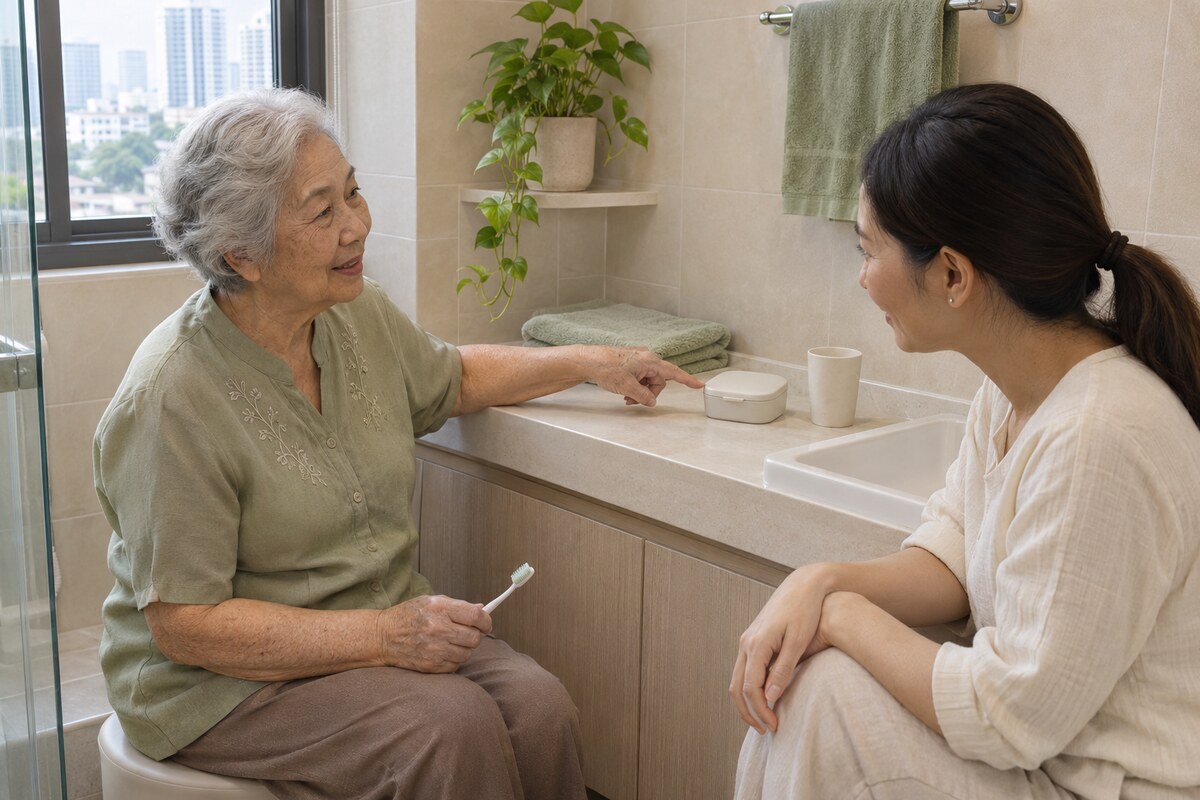
A parent who used to brush without help leaves the toothbrush dry. Someone starts avoiding crunchy food, takes out a denture before lunch, or talks less at the table. Before calling this forgetfulness or a loss of independence, ask what has become harder. Is it opening the toothpaste, reaching the basin, gripping the handle, seeing in the mirror, or discomfort on one side? Did the change start after a move, a new denture or an illness? The answer tells you whether the next step is a small practical adjustment or a call to the dentist. Thailand’s Department of Health frames oral care in later life around cleaning natural teeth and dentures, reducing risk and getting professional checks [1]. At home in Bangkok, the useful goal is not to take over brushing. It is to help the person keep as much of the routine as they want and can comfortably manage, with an agreed way to get help.
Recent Thai figures, and what they measure
The September 2026 edition of the Department of Older Persons report covers the situation in 2025. It reports a national figure of 32.07% for coverage of preventive oral-health services for older people, against a programme target of 32% (figure 13) [2]. This is a service indicator for the period reported, not the percentage of people with dental disease, not a new survey of Bangkok households in November 2026, and not a statement about eligibility at a particular clinic. It is also not a count of everyone who had any kind of dental appointment. In March 2026, WHO published guidance on less invasive ways of preventing and managing dental caries, putting prevention and shared decisions among its guiding principles [3]. The guideline evaluates clinical options; it is not a home treatment manual. Families can act on the distinction: keep a daily routine at home and ask a clinic separately what preventive or assessment appointment it offers.
Make the routine easier before doing it for someone
Ask where and when brushing feels easiest. Set up a stable seat if preferred, good lighting, and supplies within comfortable reach; bring the brush to the person if reaching the basin is the problem. For natural teeth, the Thai Department of Health recommends a suitable soft brush and fluoride toothpaste at least twice daily, in the morning and before bed [1]. A larger grip or setting out the supplies may be enough. Ask a dentist to show any adaptation that is not obvious; do not introduce an unsuitable tool just because another relative uses it. Offer one step at a time: “Would you like me to open this?” is more useful than assuming you must brush for the person. If they decline, stop rather than force their mouth open. Ask whether there is pain, fatigue, a privacy concern or simply a better time. Record repeated changes and seek advice rather than let a difficult routine quietly disappear.
Separate denture care from care of the mouth
Ask which appliances actually come out. Fixed bridges and removable dentures are not interchangeable; do not pull on an appliance you have not been shown how to handle. Thai guidance covers daily cleaning of removable dentures, removing them to clean any natural teeth, and usually removing them before sleep [1]. A dentist’s instructions take priority, especially with a new appliance or after a procedure. Ask the dental team how to clean and store that specific denture: materials differ, so avoid improvised cleaners or adhesives, and do not file or bend a plate to make it fit. A named container and a consistent place for it help prevent a denture disappearing into a tissue, a tray or a shared bathroom. Having no natural teeth does not remove the need to keep the mouth clean or report a sore. If a person coughs with mouth care, cannot reliably spit, or has a swallowing plan, ask the treating team for a routine tailored to them before offering rinses or changing the way help is given.
Published Thai example: a handout is a prompt, not a plan
Rueanphoo and colleagues reported a home-based study in rural Chai Nat on 26 April 2021. It followed 93 housebound older adults who could clean their own mouths and 95 caregivers who helped dependent older adults. Four weeks after illustrated leaflets were distributed, knowledge and practical scores improved, and dental plaque scores fell. Denture plaque did not fall significantly in the caregiver group, and knowledge gains were below the investigators’ expected improvement [4]. This was a short before-and-after study without a separate control group. It cannot isolate the leaflet’s contribution or tell us whether gains persisted or would be the same in a Bangkok household. The useful lesson is to pair an instruction sheet with a demonstration and a check that it works in the actual bathroom. Ask the person or helper to show or explain the agreed steps back, and take a question about an awkward or painful step to the dental team.
What the pneumonia research does not show
The 2022 Cochrane review included six randomised trials and 6,244 nursing-home residents. The studies were conducted in Japan, the United States and France; they compared professional mouth care with usual care rather than with no care. All had a high risk of bias, and the evidence did not establish a difference in pneumonia incidence [5]. This matters when a family hears that a cleaning routine will keep an older parent out of hospital. Research in nursing homes does not establish that brushing with family assistance prevents pneumonia at home in Thailand. It also does not make daily mouth care pointless: comfort, a manageable routine and noticing changes are independent reasons to do it. A Bangkok study published in 2018 surveyed 135 care staff in six hospitals and found gaps in knowledge about plaque and medication effects on saliva [6]. This was a questionnaire in institutions, not a measure of families’ abilities or a test of a home-care method. Ask for a demonstration rather than relying on someone’s job title.
What to write down, and when to call
A short note for the dental team can cover when a change began, what hurts or bleeds, whether the person avoids particular foods, when a denture stopped fitting well, and any new medication or change in dry-mouth symptoms. Bring the denture and a current list of medicines if the clinic requests them; do not change medicines yourself. Recurring bleeding, pain or a sore from a denture is reason to arrange an assessment; Thai guidance also flags a mouth sore that has not healed within two weeks [1]. That is not a reason to wait if symptoms are worsening. Seek urgent dental advice for painful swelling or fever with dental symptoms. Major mouth swelling, or difficulty breathing or swallowing with dental symptoms, requires emergency help rather than waiting for an appointment [7]. Advice about urgency is not a diagnosis. In Bangkok, ask beforehand about step-free access, transport, an interpreter if needed, and whether the person wants someone in the room.
Two family questions and a boundary for home support
What if a parent refuses today? If the issue is not urgent, pause and offer a different time, place or trusted helper; ask what would make the task more comfortable. New or repeated refusal may be their way of pointing to pain or difficulty without finding the right words. What if several relatives rotate? Keep one brief note, with the person’s permission: what they do independently, what help they accept, where supplies live, which problems should be passed on, and who follows up with the clinic. Share only what the person agrees to unless urgent safety requires otherwise. Companionship or personal-hygiene assistance can mean preparing supplies, helping with an agreed routine, and arranging or accompanying a visit. It is not diagnosis, fitting a denture, treating a sore, or managing swallowing difficulties independently. This article is general information, not individual dental or medical advice. When a dentist or treating team has given specific instructions, follow those and ask them to clarify any conflict.
General information for family planning, not individual medical advice. Ask the treating healthcare professional about personal care needs.
← Back to the journal