
Preventing falls at home in Bangkok: what research means for your family
Thailand’s October 2026 prevention messages, a Bangkok clinical trial and practical steps for safer daily routines—without giving up independence.
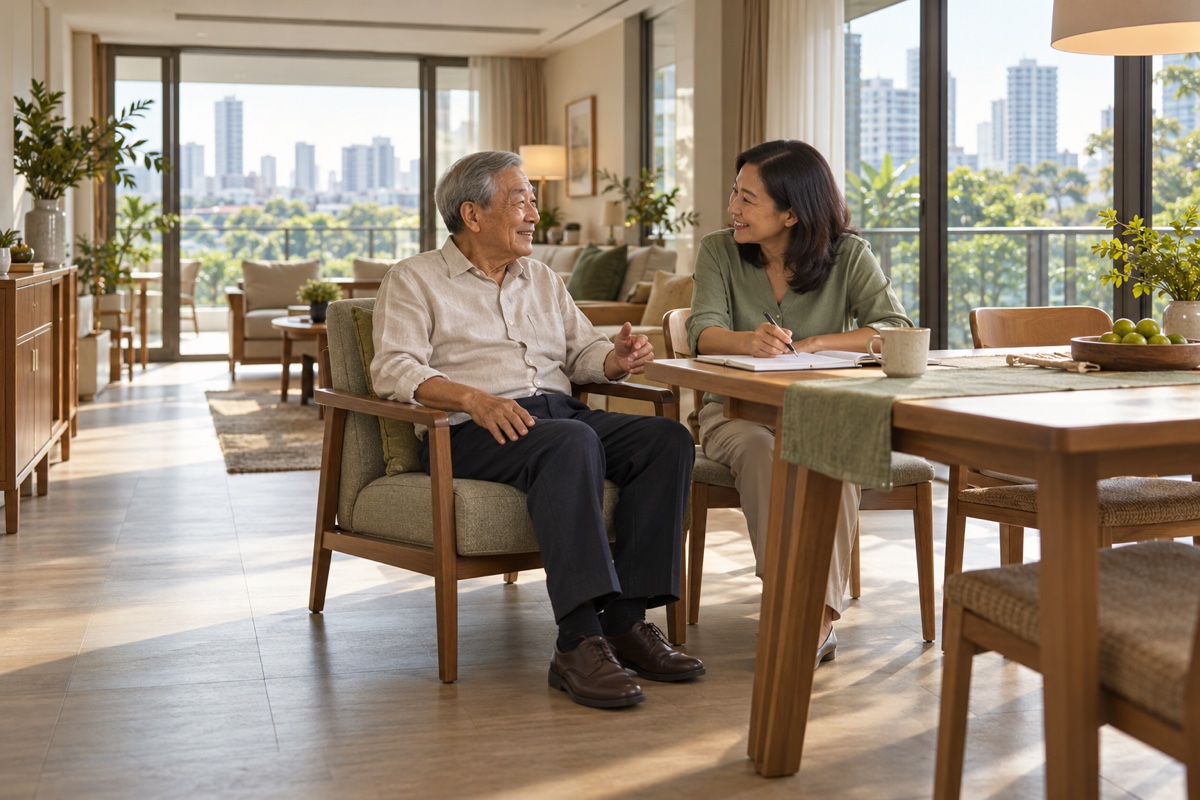
The research in brief
Thai narration · English subtitles · AI-generated presenter and illustrative footage; no real clients depicted
Read the English transcript
Fall prevention starts with understanding each person’s risks. Work with the older person to keep walkways clear, floors dry and lighting adequate. A Cochrane review found exercise programmes reduced the rate of falls by about 23%. Ask a qualified professional to select suitable strength and balance activities. Consult a clinician after a fall, or for dizziness or unsteady walking. Do not stop medicines yourself. Read the research and family planning guide at PANFOLIO.
A safer home starts with the person, not a shopping list
A parent catches a foot on a threshold, hesitates outside the bathroom or begins avoiding the walk to the kitchen. These moments deserve a conversation, even when no injury occurs. Fall prevention is not simply about buying equipment or telling someone to be careful. It brings together the person’s health, familiar routines, surroundings and the support they actually want. This PANFOLIO research guide, prepared on 19 October 2026, explains what families in Bangkok can take from current Thai public-health messages and published studies. It is general educational information, not an individual assessment or medical prescription, and is not presented as physician-authored or medically reviewed. The practical aim is to preserve everyday choices while identifying problems that need professional attention.
Why this matters in Thailand this October
On 1 October 2026, Thailand’s Department of Disease Control highlighted fall prevention during flooding and after water recedes, including wet surfaces, mud and belongings moved into walkways [1]. A separate notice on 14 October focused on older people living alone and encouraged attention to vision, balance, medication review and community contact [2]. These are dated public-health messages, not evidence that every Bangkok neighbourhood is flooded or every person living alone has the same risk. For a family, their value is a prompt to look again at ordinary routes and support arrangements. Check conditions at the actual home and building entrance. Ask the older person which journey feels least comfortable and whether recent changes have made daily tasks harder.
Look beyond the loose rug
The World Health Organization describes falls as involving several possible contributors, including mobility, balance, vision, medication effects and the environment [8]. A tidy room therefore cannot rule out a health-related cause. Ask gently about falls and near-falls, dizziness, changes in walking and fear of moving around. Note when and where a problem occurred, what the person was doing and whether something had recently changed. Bring these observations to the treating clinician rather than trying to diagnose the cause yourself. An older person should not have to demonstrate an unsafe movement to prove that a problem exists. Repeated difficulty, a fall or a noticeable change in mobility deserves professional discussion, even when the home appears well organised [6].
What the home-safety evidence actually shows
A Cochrane review published in March 2023 included 22 studies with 8,463 community-dwelling older adults; its evidence search extended to January 2021 [3]. Home fall-hazard reduction was most useful in people selected as being at higher risk, with an estimated 38% reduction in the rate of falls in that subgroup. This refers to falls counted over follow-up, not a guarantee that 38% of all families will avoid an injury. It also does not mean that buying one grab rail produces the study effect. The interventions involved assessment and action, and the review found no benefit when participants were not selected for fall risk. Evidence about serious injuries was limited. The reasonable takeaway is to prioritise an appropriate assessment and relevant changes, not promise a result from a generic checklist.
Movement helps, but the programme matters
A separate Cochrane review, published in January 2019, considered 108 randomised trials involving 23,407 participants in 25 countries, with searches through May 2018 [4]. Exercise programmes reduced the rate of falls by about 23%; balance and functional training were important components. This is established evidence, not a new 2026 discovery, and it does not establish that any unsupervised exercise routine is suitable for every reader. An older person recovering from illness, experiencing dizziness or struggling to stand needs an individual plan. Ask a physiotherapist or treating clinician which activities, assistance and progression are appropriate. A family member can help organise the agreed routine and report difficulties. Increasing activity should support confidence; it should not become a test of courage or a competition to complete repetitions.
A published Bangkok case study: the FREED trial
A useful local research example is the FREED randomised trial, published on 6 November 2025 in BMC Emergency Medicine [5]. It enrolled 216 adults aged 60 or over after a recent fall at a Bangkok emergency department; recruitment occurred from 2019 to 2022. At six months, repeat falls were reported in 20.4% of the intervention group and 25.0% of the usual-care group. The difference was not statistically significant. The study therefore does not prove that its combined assessment and referral approach prevented repeat falls. Its single-centre setting, smaller-than-planned recruitment and shortened follow-up limit the conclusions. This is an analysis of published research, not a PANFOLIO patient story. It illustrates why local experience matters and why a promising-looking percentage should not be turned into a commercial guarantee.
Turn a room check into a shared action plan
Start with one route the person uses frequently: bed to bathroom, favourite chair to kitchen, or apartment door to lift. Look together at loose cables, unstable objects, changes in floor level, lighting and slippery surfaces [1,6]. Avoid rearranging everything without consent; a familiar layout can be important to the person living there. Write down three specific concerns, the person responsible for each and when you will check progress. A damaged light may need a building repair; a difficult shower entrance may need an occupational therapist or another qualified professional to assess suitable adaptations. Choose equipment for the person and the setting, and have fixed supports installed appropriately. Removing clutter should create a usable route, not transfer the obstacle to the next room.
Adapt the plan to Bangkok daily life
Prevention continues beyond the front door. As a practical planning exercise, agree who will check the lift, entrance, vehicle boarding point and destination before a hospital visit. Leave enough time so the older person is not rushed through unfamiliar spaces. If rain has made an entrance slippery, choose a safer route or ask building staff for help instead of treating the original plan as fixed. For someone living alone, agree on check-in times and what to do if a call is missed. Keep a phone or suitable alert device accessible [6], while recognising that it cannot prevent a fall by itself. Discuss privacy and preferences before sharing access details with relatives, building staff or a companion. These arrangements should make help easier to obtain without unnecessarily taking control away.
An illustrative family scenario, not a patient testimonial
Consider a fictional older Bangkok resident who wants to keep living independently but recently slipped near the bathroom. Their daughter notices dim lighting and that appointments have become stressful. This invented scenario is for learning; it reports no real PANFOLIO client or treatment outcome. The family’s first step is to arrange appropriate assessment after the fall, not assume the floor explains everything. Together they list the difficult route, request advice about the bathroom and prepare observations for the clinical visit. A companion could help with agreed appointment logistics and record instructions with permission. The family then reviews whether the changes were completed and whether further difficulty has occurred. Success cannot be inferred from one quiet week, and new symptoms still require professional attention.
When to seek help after a fall
Do not treat a fall with significant pain, inability to get up or suspected injury as a routine home-care visit. Thailand’s Department of Disease Control advises against moving a person yourself when severe pain, inability to move or suspected fracture is present, and identifies 1669 for emergency help [1]. Suspected head, neck, back or hip injury also warrants urgent assessment [6]. After a head injury, loss of consciousness, inability to stay awake, a seizure, new weakness or difficulty speaking are emergency warning signs [7]. Seek urgent medical advice after a head injury if the person takes blood-thinning medication, even when the injury initially seems minor. Follow emergency-service instructions; do not improvise lifting techniques. The UK contact numbers on NHS source pages do not apply in Thailand.
Where home support fits—and where clinical care begins
Home support can help a family organise an agreed daily routine, prepare for appointments and communicate observations with the older person’s consent. Personal hygiene assistance may also require careful planning around a difficult bathroom. For PANFOLIO services, confirm the exact tasks, relevant qualifications and required level of assistance before arranging support. A companion is not automatically a physiotherapist, nurse or medical interpreter. Keep medication decisions with the prescribing clinician or pharmacist; do not stop or alter treatment because a website mentions falls. Use a short shared record: what happened, what the clinician advised, who will act and when the plan will be reviewed. This supports continuity without claiming that companionship alone prevents falls or replaces assessment and rehabilitation.
Questions families often ask
Should we wait for a serious fall before acting? No: concerns about balance, mobility or a previous fall are worth discussing with a clinician [6]. Is removing rugs enough? No: the person’s health and routines also matter, and home changes should match the identified risks. Should an older person stop walking altogether? Avoid making that decision from fear alone; seek advice about safe, suitable activity. Does living alone automatically mean someone must move? No: discuss individual needs, preferences and realistic support rather than deciding from a population-level message. What can we do this week? Agree on one priority with the older person, prepare a list of concerns for the appropriate professional and assign practical follow-up tasks. Research informs these conversations; it cannot predict an individual outcome. Sources below were checked on 19 October 2026.
General information for family planning, not individual medical advice. Ask the treating healthcare professional about personal care needs.
← Back to the journal