
Thailand’s ageing population: the numbers behind the growing need for care at home
About 14 million people aged 60+, changing households and a measurable gap in everyday assistance: an evidence-based guide to Thailand’s ageing population, with official statistics, workforce projections and a Chiang Mai case study.
The research in brief
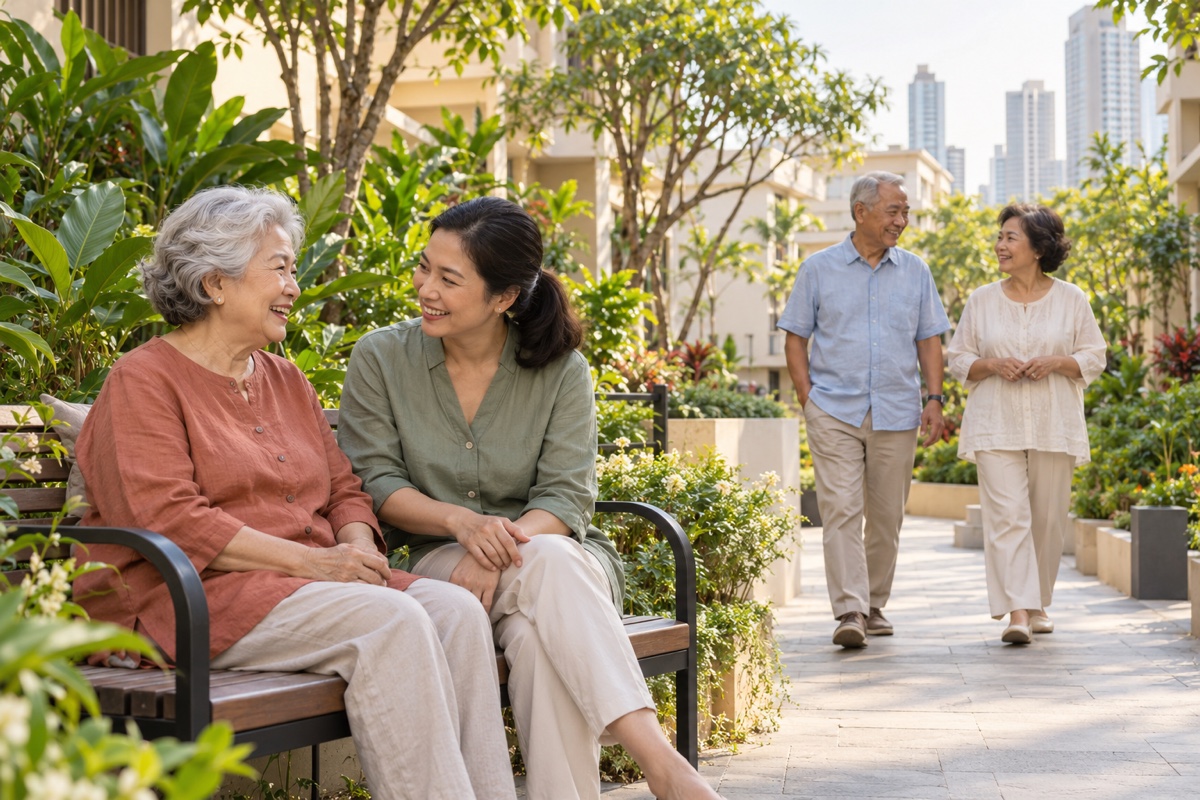
Thai narration · English subtitles · AI-generated presenter and illustrative footage; no real clients depicted
Read the English transcript
Thailand’s population is ageing. The 2024 survey estimated about 14 million people aged 60 and over. But being older does not mean everyone needs assistance. Among those reporting a need for daily-living care, about 22.4% had no caregiver. Plan around the person’s abilities, support needs and family availability. Read the full research guide at PANFOLIO.
1. A demographic change, not a diagnosis
Thailand’s ageing population raises a practical question for families: who can help an older relative continue the life they value, and what kind of help is actually needed? Being 60, 75 or 85 does not itself establish dependence. Many older people work, support grandchildren and participate in their communities. Others need occasional accompaniment, help with personal care, or clinical treatment. These are different needs. This dossier, researched on 24 October 2026, brings together a national household survey, population-registration figures, workforce research and a published Thai care intervention. The principal observed statistics describe 2024, not a live count for 2026. Forecasts for 2033 and 2037 are identified separately. The aim is to make care planning more informed without treating every older person as a patient or a potential purchaser of private services. [1–4]
2. The national picture: approximately 14 million people aged 60+
Thailand’s National Statistical Office (NSO) estimates 14,027,411 people aged 60 and over in its 2024 Survey of Older Persons, equivalent to 20.0% of the population. The survey series recorded 6.8% in 1994: the share has nearly tripled over three decades. Among older people represented by the 2024 estimates, 59.3% were aged 60–69, 29.8% were 70–79 and 10.9% were 80 or older; women accounted for 57.9%. Those age-group percentages use older people, not the entire population, as their denominator. They describe a diverse group, not a uniform level of support. The survey interviewed a sample of 86,880 households between April and June 2024 and produced weighted national estimates. Its household design is important: people living in institutions are outside its private-household frame. Counts should therefore be read as survey estimates, not as individual administrative registrations. [1]
3. Why another official report says 13.7 million and 20.83%
The Situation of the Thai Older Persons 2024 report presents a different statistical series: Department of Provincial Administration figures dated 31 December 2024. It records 13,736,996 people aged 60+ within a total population of 65,951,179, giving 20.83%. This is not the same numerator, population base or reference date as the NSO household survey. Both figures can be correctly reported, but they must not be mixed to manufacture a percentage or an apparent growth rate. This article uses the NSO survey for household circumstances and reported assistance needs, and identifies registration-based figures explicitly. International comparisons also require caution: some reports define older age from 65, while Thai survey tables here use 60. A 20% share of people aged 60+ and a 20% share aged over 65 describe different demographic milestones. [1,2]
4. Living alone is rising, but it does not measure dependence
In the NSO survey, 12.9% of older people lived alone in 2024, compared with 3.6% in 1994. A further 22.6% lived only with their spouse. Together, these two household arrangements account for 35.5% of older people, calculated by adding the published percentages. They do not mean that 35.5% need a caregiver. Living alone can reflect independence and preference; living with family does not guarantee that someone is available throughout the day. For planning, ask about actual routines: getting to appointments, shopping, preparing meals, communicating concerns and managing a temporary illness. A couple may manage comfortably until one partner is admitted to hospital. The useful question is not simply how many people share the address, but whether a reliable support plan exists when normal arrangements change. [1]
5. Fewer potential supporters, not fewer loving families
The NSO’s potential support ratio fell from 9.3 people aged 15–59 for each person aged 60+ in 1994 to 3.2 in 2024. This is a population age-structure indicator. It does not mean that each older person has 3.2 available carers, nor that every person of working age is employed or able to provide assistance. It helps explain why relying entirely on an assumed pool of relatives becomes harder as the population changes. For an individual family, practical constraints may include distance, work schedules, the caregiver’s own health and the needs of children. Support should therefore be organised around real availability, not expectations based on family size. Asking for planned relief can preserve family relationships and continuity of care; it is not evidence that relatives have failed in their responsibilities. [1]
6. The more direct measure: 924,732 reporting a need for a caregiver
Table 50 of the NSO report estimates that 924,732 older people needed a caregiver for daily living activities in 2024. Dividing this by the survey’s 14,027,411 people aged 60+ gives approximately 6.6%, a calculation made for this article. Within that group, 207,377 reported having no caregiver: about 22.4% of those reporting a need, not 22.4% of all older people. The table records 717,084 with a caregiver and 271 with unknown caregiver status. These are important signals of unmet assistance, but not a clinical assessment of every resident, a count of people needing round-the-clock nursing, or an estimate of customers able to pay privately. Survey-reported need and the household sampling frame may miss other forms of difficulty. People who do not need help with basic daily activities may still benefit from transport, appointment accompaniment or social contact. [1]
7. Match assistance to the task, and protect the person’s choices
A useful care discussion separates personal daily activities, practical organisation and healthcare. Personal assistance may involve washing, dressing, eating or moving safely. Practical support may involve shopping, preparing for a hospital appointment, transport or companionship. Clinical concerns require the appropriate qualified health professional; companionship cannot replace diagnosis, nursing or rehabilitation. WHO’s healthy-ageing approach focuses on what people can do within their environment, not age alone. Start by asking the older person what matters to them and which tasks are becoming difficult. Record when help is needed, what they want to continue doing themselves and who can step in if the usual helper is absent. Any new or worsening loss of function deserves professional assessment rather than an automatic increase in a generic care package. This is a planning framework, not a medical screening tool. [3]
8. The workforce outlook: what the ILO’s 2037 scenarios actually mean
An International Labour Organization study published on 29 October 2025 projects at least a 70% increase in the need for paid home-based care workers by 2037 under a scenario retaining current working conditions. That scenario does not close existing access gaps or fully protect workers’ hours and rights. A separate scenario addressing care gaps and decent working conditions points to approximately 250,000 additional paid care workers. These are modelled future requirements, not a measured shortage of 250,000 workers today. The study combines quantitative and qualitative evidence with foresight analysis. Its practical implication is that expanding access and improving employment conditions must be planned together. For families considering paid support, clear duties, suitable skills, rest arrangements, continuity and a realistic budget matter as much as simply finding someone available. Demographic growth alone cannot tell us what any one household should purchase. [4]
9. A published Thai case: community support in Chiang Mai
A 2022 study evaluated community-integrated intermediary care (CIIC) in Chiang Mai: group and home exercise, family-caregiver training and community respite care. It involved 2,788 participants across 12 village clusters, with six intervention and six comparison clusters. At six months, the mean proportion of families with reduced caregiver burden was 39.4% in intervention clusters and 28.62% in comparison clusters. This is a comparison of proportions reporting improvement, not a 39.4% reduction in everyone’s burden. WHO’s project summary also reports less functional decline but no demonstrated improvement in quality of life. Interpretation needs restraint: follow-up was short, the pandemic disrupted implementation, and villages were sampled within separately designated intervention and comparison municipalities. Results from this local, multi-component programme cannot establish the effect of one private home-care visit or guarantee the same outcome in Bangkok. Its useful lesson is to support both older people and their family caregivers through coordinated services. [5,6]
10. October 2026: longevity is also a question of public organisation
The World Bank’s Thailand Country Aging Report, dated 14 October 2026, says in its official summary that Thailand is on course to have more than 20% of its population over 65 by 2033. This is a projection using a different age threshold from the NSO’s 60+ statistics. The report calls attention to coordination across health, social protection and local government. On 1 October 2026, WHO’s South-East Asia statement likewise highlighted fragmented financing, workforce shortages and insufficient support for family and professional caregivers across the region. It also acknowledged Thailand’s progress on integrated and long-term care. These publications support an important distinction: Thailand already has care initiatives; the challenge is access, coordination and sustainable support. Regional observations are not Thailand-specific prevalence estimates, and neither publication means that private care should replace public services or family participation. [7,8]
11. Turn national evidence into a practical family plan in Bangkok
Use the figures as a reason to prepare, not as a diagnosis of your relative. Agree on priorities with the older person: staying socially connected, getting to appointments, preserving privacy or receiving help with a specific daily task. Make a weekly schedule showing who is genuinely available and where gaps remain, including evenings and caregiver breaks. Keep appointment information, the current medication list supplied by the treating team and useful contacts accessible with the person’s consent. Discuss relevant public or community support with the local health service; eligibility and availability must be checked individually. If supplementary paid assistance is needed, ask for a clear scope, verified task-appropriate qualifications, supervision arrangements where relevant and a replacement plan. Review the arrangement after a hospital stay or a change in independence. PANFOLIO’s service categories can help frame this conversation, but the required level of assistance should follow an individual assessment, not national averages.
12. Questions families ask, and how to read this dossier
Does every older person need a caregiver? No: age alone does not establish need, and the NSO’s 6.6% figure concerns reported caregiver need for daily activities within its household survey. Does living alone mean someone is unsafe? Not automatically; review abilities, preferences, the home and reachable support. Are the 250,000 workers missing today? No: that number belongs to an ILO future scenario. Can these national figures describe Bangkok precisely? No: we do not present them as city-level estimates. Method: sources were checked on 24 October 2026; observations from 2024, a 2022 intervention study and later policy projections are labelled separately. Percentages 6.6%, 22.4% and 35.5% are transparent calculations from NSO tables, rounded to one decimal place. This is general editorial information, not individual diagnosis or treatment, and no physician review is claimed. The original AI-generated illustration depicts fictional people, not PANFOLIO staff, clients or study participants.
General information for family planning, not individual medical advice. Ask the treating healthcare professional about personal care needs.
← Back to the journal