
Flu prevention for older adults in Bangkok: a family guide for 2026
Thailand’s November 2026 winter warning, recent Thai research and a practical plan for vaccination reviews, early symptoms, safer home support and urgent warning signs.
The research in brief
Thai narration · English subtitles · AI-generated presenter and illustrative footage; no real clients depicted
Read the English transcript
Influenza can be serious for older adults, especially those with chronic conditions. Families in Bangkok should prepare. Review vaccination records and ask a clinician about the annual flu vaccine. With a new cough or unusual fatigue, seek prompt clinical advice, especially for someone at higher risk—even without fever. Breathing difficulty, chest pain or confusion need urgent medical help. Do not wait for a scheduled care visit. Prepare medicine and appointment records, wash hands regularly and postpone visits when unwell. PANFOLIO can support daily routines and hospital accompaniment. Read the full article for guidance and sources.
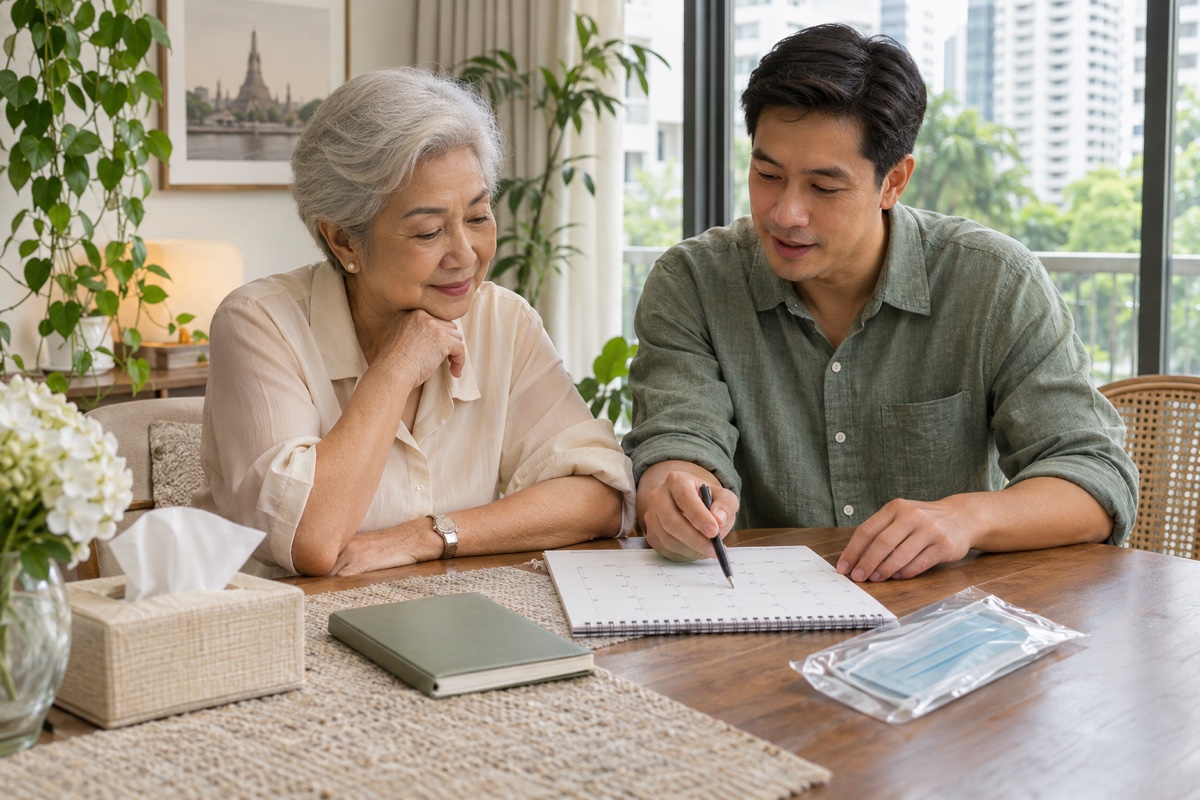
Illustrative AI-generated photograph; no real client depicted.
Thailand’s November 2026 warning: what families should do now
On 10 November 2026, Thailand’s Department of Disease Control warned about winter respiratory infections, including influenza, pneumonia, RSV and COVID-19. Older people and those with chronic conditions were singled out for extra attention [1]. This is a preparedness message, not evidence that every Bangkok neighbourhood is experiencing an outbreak. For a family arranging elderly care at home, the useful response is practical: check vaccination records, decide who will contact the clinic, and agree how support continues if a relative or caregiver becomes ill. This guide was researched on 16 November 2026. It focuses on seasonal influenza and everyday assistance; it does not diagnose a cough or replace a clinician’s assessment. In tropical settings, influenza can circulate throughout the year, so a northern-European winter calendar should not determine every decision in Thailand [3].
What the latest Thai surveillance does—and does not—tell us
A November update from Thailand’s Department of Medical Sciences describes laboratory surveillance covering January–October 2026. A(H1N1)pdm09 was the influenza type/subtype most frequently detected in that surveillance, while genetic analysis found no mutations indicating antiviral resistance in the samples analysed [2]. Those findings support continued monitoring. They do not establish that an individual has that strain, that every circulating virus is susceptible, or that treatment can be chosen at home. Equally, a national laboratory sample is not a count of infections among older Bangkok residents. Avoid sharing undated case totals in family chats. When forwarding an alert, retain its issuing organisation, publication date and geographical scope. For a new illness, the person’s symptoms and medical history matter more than guessing which variant a headline describes.
Why an older adult’s baseline matters
Influenza often begins abruptly with cough, aches, fatigue or fever, but not everybody develops fever. Adults aged 65 and over and people with certain long-term conditions have a higher risk of serious complications [4]. A normal temperature therefore cannot be used as a complete reassurance. Before anyone becomes unwell, note the older person’s usual appetite, mobility and ability to manage routines. Ask what help they would want if those routines became difficult. Keep an accessible list of diagnoses, prescribed medicines, allergies and the usual clinic. A companion can record a change and share it accurately; determining its cause requires clinical judgement. Let the older person participate in these preparations rather than treating age alone as proof that they cannot make decisions.
Vaccination: arrange a review, not a guaranteed outcome
WHO recommends annual influenza vaccination, particularly for people at higher risk and their carers [3]. Protection is not absolute, and the appropriate product and timing should be discussed with a local clinician. Bring the record of previous doses, relevant allergies and any previous serious reaction. Ask what is available in Thailand and whether vaccination is appropriate now. Eligibility for a publicly funded dose, stock and appointment arrangements should be checked directly with the provider; this article does not promise a free November appointment. A practical family role is to arrange transport, help with the paperwork and write down the professional’s advice. Keep vaccination decisions separate from sales claims: neither a home-care package nor a vaccine can guarantee that influenza will never occur.
A 2026 Thai study: useful local evidence with clear limits
Arunothong and colleagues published a phase IV test-negative case-control study online on 8 September 2026, in the October collection of The Lancet Regional Health – Southeast Asia. It examined a trivalent inactivated influenza vaccine among adults presenting with influenza-like illness in Lampang during the 2024–2025 season [5]. In a test-negative design, researchers compare vaccination histories in symptomatic people who test positive and negative. This differs from randomly assigning all participants to vaccination. Healthcare-seeking behaviour and other differences may affect observational estimates. The authors state that effectiveness against hospitalisation could not be reliably estimated because severe outcomes were too few. It would therefore be misleading to turn this study into a percentage promise about preventing admission in Bangkok seniors. Its local setting adds relevance, while its population, season and design limit direct transfer to an individual.
The first symptoms: contact the clinician promptly
For a higher-risk older adult with suspected influenza, seek clinical advice promptly rather than waiting for several days of fever. CDC guidance updated on 26 June 2026 explains that prescription antivirals work best when started within one to two days, and recommends prompt treatment assessment for people at increased risk [6]. That timing is a reason to make contact early, not a deadline after which help is pointless. Severe or progressive illness still requires assessment. Tell the clinic when symptoms began, what has changed, current medicines and underlying conditions. Ask whether and where testing or an examination is needed. Do not start a relative’s leftover medicine, choose a dose from this article or assume that antibiotics treat influenza. Treatment and testing decisions belong to the treating professional.
Home support when someone is ill
CDC’s home-care advice emphasises limiting close face-to-face contact with the sick person, hand hygiene, cleaning frequently touched objects and steps for cleaner air; a mask can add protection [7]. Turn these principles into a workable household arrangement. Identify who delivers meals, where tissues are disposed of and which person updates the family. Give a sick visitor an easy way to postpone without guilt. An unwell caregiver should report symptoms so replacement or a revised plan can be considered. These are planning steps, not a claim that a particular service can always provide a replacement. Avoid forcing the older person to manage a complicated cleaning programme while ill. Focus on necessary help, rest, dignity and the medical advice already received.
A Bangkok complication: ventilation and PM2.5
Cleaner indoor air and reducing unnecessary close contact both matter, but opening every window regardless of outdoor pollution is not a universal solution. Bangkok families may need to consider air-quality conditions when planning ventilation. Our separate PM2.5 guide explains how to use official readings and organise daily activities; use it alongside the clinician’s instructions rather than treating it as an infection-control prescription. Keep entrances and walkways clear if supplies, laundry or a temporary chair are moved. Put commonly needed items within safe reach. For practical assistance with personal hygiene, agree the task and the person’s preferences before care begins. A comfortable, orderly home supports an agreed plan; it does not make the home a substitute for medical care.
Warning signs: do not wait for a routine care visit
Seek urgent medical help for breathing difficulty, persistent chest or abdominal pain or pressure, persistent dizziness or confusion, inability to wake normally, seizures, not urinating, severe weakness or unsteadiness, or illness that improves then returns or worsens. Worsening of a chronic condition is another warning sign [4][7]. This list is not exhaustive: any severe or concerning change deserves professional attention. Do not wait for a scheduled companion, a positive test or a temperature threshold before escalating. Decide in advance which family member can accompany the person and where essential records are kept. Routine hospital accompaniment is different from emergency response. A commercial enquiry form or a blog comment should never be used to request urgent clinical assistance.
Educational scenario: one family’s handover plan
Consider a fictional 76-year-old Bangkok resident living with her son, who works outside the home. She develops a new cough and unusual fatigue. This is an educational example, not a PANFOLIO client or a measured outcome. The son notes symptom onset, checks for urgent warning signs and contacts her usual clinic promptly, mentioning her existing conditions. He asks a sibling to organise transport if the clinician requests an examination. A household helper prepares everyday essentials and records agreed tasks, without diagnosing influenza or changing medicines. If the son becomes ill, the family reviews close-contact arrangements rather than assuming he must continue as usual. The lesson is the clarity of responsibility: observation, clinical decisions and practical support have different owners.
- 01Prepare records
- 02Notice changes
- 03Contact the clinician
- 04Arrange practical support
A family checklist and where PANFOLIO fits
Before the next busy week, agree five things: the clinic to contact; the location of vaccination and medicine records; who notices and reports changes; who handles appointments; and what happens if the usual helper is unwell. Bring questions about prevention to the clinician. For non-emergency assistance, explore PANFOLIO’s companionship, medical-appointment coordination and hospital-companion services. Discuss the specific tasks, hours and needs before making arrangements. Qualification checks and clinical responsibilities should be explicit; this article does not establish an individual caregiver’s credentials. A useful care plan reduces uncertainty without taking away the older adult’s choices. Revisit the plan after medical advice or changes in daily ability, and use the appointment checklist to prepare a concise handover.
Questions families ask
Can influenza happen outside Thailand’s cooler months? Yes: WHO notes that tropical regions can have circulation throughout the year [3]. Does vaccination remove the need for early advice? No; a high-risk person who becomes unwell still needs prompt assessment. Is every cough influenza? No: several respiratory illnesses can look similar, and a clinician decides whether testing is needed. Should relatives wait for a high fever? No; influenza can occur without fever, and severe warning signs require urgent help [4]. Is home assistance medical treatment? Everyday support can help implement an agreed routine, while diagnosis, prescriptions and clinical procedures remain with appropriately qualified professionals. The accompanying WHO video explains general vaccination principles; it was published in December 2024 and is not a new Thailand surveillance bulletin [8].
Watch: WHO explains influenza vaccination
WHO Science in 5 · 12 December 2024 · English · 5:42. General education; not a Thailand 2026 update.
General information for family planning, not individual medical advice. Ask the treating healthcare professional about personal care needs.
← Back to the journal